Case study: Gypsy, Roma and Traveller (GRT) Engagement
Introduction
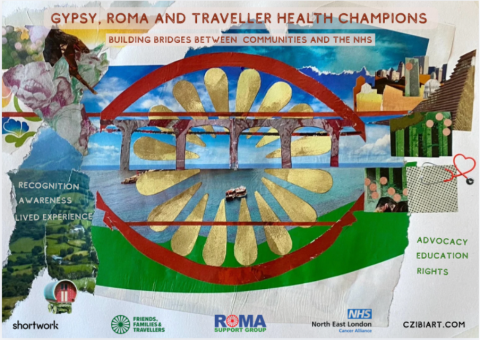
North East London Cancer Alliance developed and delivered a Gypsy, Roma and Traveller Engagement Project to address persistent inequalities in cancer prevention, screening and early diagnosis experienced by Gypsy, Roma and Traveller communities.
The programme responded directly to CORE20PLUS5 priorities by combining community-led engagement with system-level change.
What did we do?
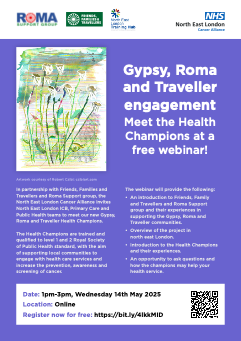
Working in partnership with Friends, Families and Travellers and the Roma Support Group, North East London Cancer Alliance recruited and trained 13 paid Health Champions from Roma, Irish Traveller and New Traveller communities.
Champions completed accredited Royal Society for Public Health Level 1 and 2 training in health improvement and behaviour change, alongside specialist cancer awareness sessions focused on breast, bowel, cervical and lung cancer. Training was adapted to be culturally safe and accessible, accounting for literacy, language and digital barriers.
Health Champions used their lived experience and trusted community networks to share cancer information, encourage screening, support navigation of primary care, and challenge discrimination when encountered. This peer-led model enabled conversations about taboo subjects such as cancer in ways that statutory services alone cannot achieve.
Alongside community engagement, the project delivered 12 lived-experience-led cultural awareness training sessions for healthcare professionals across North East London. Co-delivered by Gypsy, Roma and Traveller (GRT) charities and Health Champions, these sessions addressed GRT history, discrimination, structural barriers to access, and practical changes to improve inclusion. Over 90 staff from primary care, public health, screening and system leadership roles took part.
The project was independently evaluated using mixed methods, including surveys, interviews and workshops, to capture impact across communities, champions and professionals.
This project marked the first time that Friends, Families and Travellers and the Roma Support Group had brought together a cross-community cohort of Health Champions from different Gypsy, Roma, and Traveller communities.
Delivery partners highlighted the value of this innovative approach, noting high levels of motivation, enthusiasm, and willingness to return among participants. They particularly praised the mixed-cohort model, which enabled cross-cultural learning, peer support, and the sharing of experiences between communities that rarely interact.
“We had thought that people would prefer culturally-specific training, but actually the Health Champions really enjoyed bonding, finding similarities, and differences - creating a feeling of being included. If they had something to share that was different, it was heard and appreciated.”
What was the impact?
The project delivered clear, measurable impact across individuals, communities and the health system.
For Health Champions:
Accredited training led to substantial gains in knowledge, confidence and advocacy skills. Awareness of health services increased from 25% rating themselves “very aware” pre-training to 92% post-training.
Confidence discussing cancer screening rose from 58% to 92%, while confidence supporting others to navigate screening pathways increased from 50% to 92%.
Knowledge of screening eligibility improved markedly: correct identification rose from 0–50% pre-training to 73–92% post-training across bowel, breast and cervical screening.
After Level 2 training, 100% of Champions rated their understanding of health inequalities, social determinants of health and communication skills as good or very good.
All Champions reported increased personal health confidence, with many describing tangible behaviour change, including reduced smoking and vaping, weight loss, healthier diets and increased physical activity. Formal accreditation (RSPH Level 2) and payment significantly strengthened confidence, legitimacy and professional identity.
Health Champions themselves consistently emphasised the positive impact of being brought together across communities. Participants described the programme as a rare intercultural connector, allowing them to recognise differences, identify shared experiences, and learn from one another:
“It was really good to meet people from other groups. We don’t usually get this chance.”
“Even though we’re different, I saw how much we have in common and learned a lot from others.”
For Gypsy, Roma and Traveller communities:
Champions generated early “community multiplier” effects through family and peer networks. They supported relatives and community members to register with GPs, attend screening, understand NHS letters and challenge inappropriate refusals of care.
Champions reported increased openness about cancer, reduced stigma and fear, and improved awareness of prevention and early diagnosis. Several instances were documented where Champions successfully challenged discriminatory practice in primary care, resulting in apologies and staff retraining.
In some cases, these interventions led to tangible improvements likely to impact positively on health outcomes, such as early cancer checks or lifestyle changes among family members.
Within their communities, Champions observed that cancer is often a taboo topic. Through their peer-led interactions, they reported shifts in attitudes, including more open conversation, reduced fear and fatalism, and increased knowledge about prevention, early diagnosis, and treatment:
“The taboo around cancer is changing… people are more open to talking”
For healthcare professionals:
Mean rating across the 12 sessions was 4.63/5, with 73% rated “excellent.”
Awareness of GRT health inequalities increased significantly: pre-training mean awareness was 2.1/5, with only 5% rating themselves as good or expert; post-training this rose to 3.4/5, with 56% rating their awareness as good or expert. Staff reported concrete intended changes to practice, including adapting communication, checking literacy assumptions, improving screening outreach and sharing learning with colleagues.
Overall, the programme measurably improved knowledge, confidence, cultural safety and trust, which are critical precursors to improved access, earlier diagnosis and better health outcomes for GRT communities.
“My dad is now smoking less and eating less sugar.”
“A friend called about smear tests - I could tell her she could bring someone with her. She trusted me because I knew my stuff."
What happens next?
Building on the pilot’s success, North East London Cancer Alliance aims to sustain and scale the GRT Health Champions model as part of a longer-term approach to reducing cancer inequalities.
Recommended next steps include securing multi-year funding to maintain paid Health Champion roles, provide refresher training, and support supervision through trusted voluntary sector partners.
The cancer alliance will work with system partners to embed Health Champions into primary care, screening and public health pathways, with clear role definitions, referral routes and safeguarding arrangements.
The programme could expand culturally co-designed cancer resources and outreach approaches, ensuring materials are accessible, relevant and delivered through trusted channels. There is also strong appetite to extend the model to other prevention priorities, including vaccination and long-term condition management.
Addressing data gaps, particularly ethnicity coding and service engagement metrics, will be crucial to enable robust evaluation of population-level impact and to inform targeted interventions.
North East London Cancer Alliance will strengthen evaluation by improving capture of GRT ethnicity data, monitoring reach and engagement, and documenting community-level outcomes such as screening access and earlier presentation. Learning from this pilot will be shared across the Integrated Care System and beyond.
Ultimately, the project provides a scalable, evidence-based model for addressing entrenched inequalities through lived-experience leadership, partnership with the voluntary sector, and system-wide cultural change, supporting more inclusive, equitable cancer outcomes across north east London.
The evaluation confirms that the Health Champions pilot is an effective, culturally informed approach to engaging GRT communities, empowering Champions, and enhancing professional practice. The evidence strongly supports continuation, system embedding, and expansion of the model to achieve enduring impact.
GRT Resources
To support with cancer awareness in the GRT communities, here are some materials produced by Friends, Families and Travellers and Roma support group.